
It Takes Light 24 Hours to Reach Voyager 1 — Let That Sink In

In this video, we break down what “one light-day” actually means, how Voyager 1 got there after nearly 50 years of flight, and why a signal traveling at 299,792 km/s still takes a full day to close the gap. We also look at what’s next for the spacecraft as it pushes deeper into interstellar space on a dying power supply.
Here is a list of fun facts about Voyager 1
Speed-of-light / EM wave travel times
- Radio station (city centre) → outskirts listener: ~83–133 microseconds
- Local radio signal reaching a listener: ~100 microseconds
- New York → California radio signal: ~13 milliseconds
- Coast to coast Europe (Lisbon → Moscow): ~13.0 milliseconds
- Coast to coast Europe, narrower span (Lisbon → Warsaw): ~9.7 milliseconds
- Light doing one full lap around Earth’s equator: ~133–134 milliseconds
- Light circling Earth: ~7.5 times per second
- Earth–Moon laser ranging round trip (Apollo reflectors): ~2.56 seconds
- Geostationary satellite phone call round trip: ~477 milliseconds
- Sunlight reaching Earth: ~8.32 minutes (8 minutes)
- Voyager 1’s signal reaching Earth (one-way, at the light-day milestone): ~24 hours (1 light-day)
Voyager 1’s core distance (the light-day milestone)
- 16.1 billion miles / 25.9 billion kilometers from Earth
- Equivalent to ~173 AU (Astronomical Units)
- 1 light-day (the distance light travels in 24 hours)
Reference distances used for comparison
- Earth ↔ Sun (1 AU): ~93 million miles
- Earth ↔ Moon (average): 238,855 miles
- Earth’s circumference (equatorial): 24,901 miles
- Earth’s orbital path circumference (around the Sun): ~584 million miles
- Earth ↔ Pluto (average): ~3.67 billion miles
- 1 light-year: ~5.879 trillion miles
Voyager’s distance expressed as multiples
- ~173 times the Earth–Sun distance
- ~67,400 times the Earth–Moon distance
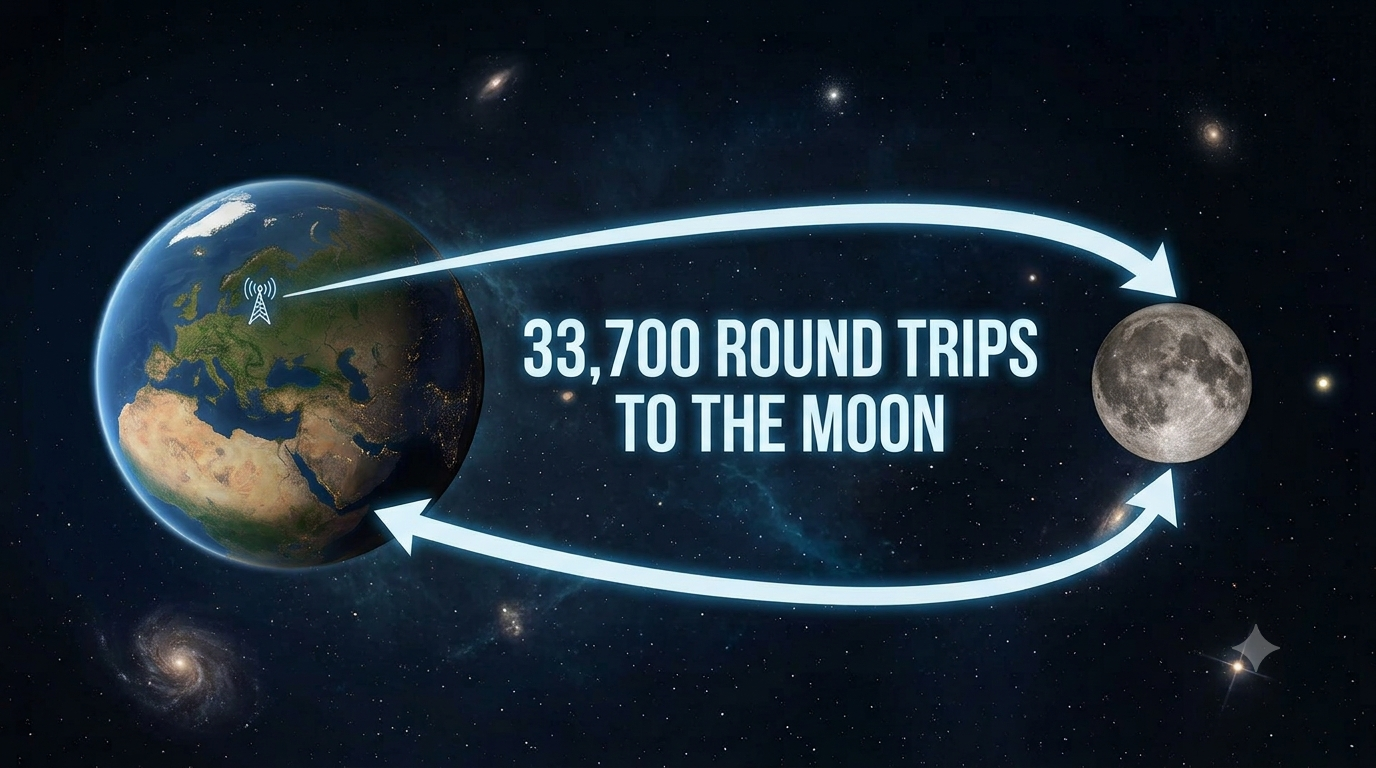
- ~33,700 round trips to the Moon
- ~646,000–650,000 times Earth’s circumference
- ~27.6 laps around Earth’s orbital path
- ~4.4 times the distance to Pluto
Zooming out further
- Proxima Centauri (nearest star to our solar system): 4.24 light-years ≈ ~25 trillion miles (24–25 trillion, depending on rounding used)
- Voyager’s 16.1 billion miles as a fraction of that: ~0.0027% of the way there
EM wave / radio distance comparisons
- City-centre radio station → outskirts listener: ~25–40 km
- US coast to coast (LA ↔ NYC): ~3,940 km
- Europe coast to coast (Lisbon ↔ Moscow): ~3,900 km
- Europe, narrower span (Lisbon ↔ Warsaw): ~2,900 km
- 1 AU (Sun ↔ Earth, used for the sunlight example): 149.6 million km
- Geostationary satellite altitude (round trip signal path, ×4): 35,786 km one-way
- Earth ↔ Moon (laser ranging example): 384,400 km
Fiber optic cable examples
- Transatlantic cable (NYC ↔ London): ~5,570 km one-way
- Round-the-world single cable (great circle): ~40,075 km one-way / ~80,150 km round trip
Oort Cloud / solar system boundary
- Distance to the heliopause (where Voyager 1 crossed into interstellar space): reached in 2012, no single figure given, but marks the edge of the Sun’s solar wind influence
- Oort Cloud: described only in time-to-reach terms (~300 years to inner edge, ~30,000 years to cross), no distance figure was calculated